

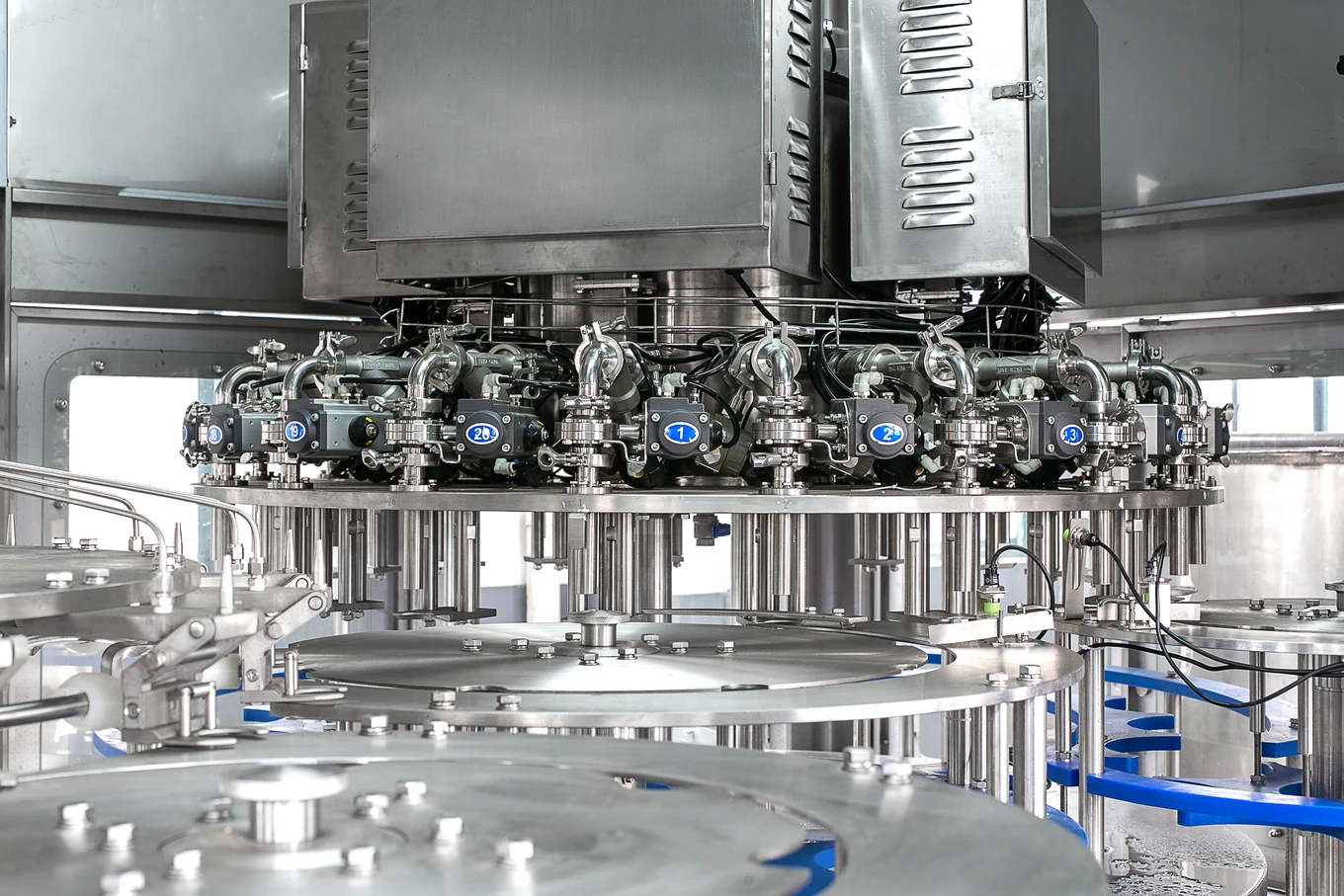
Choosing a filling machine is not simply a matter of picking the fastest or least expensive option. The right choice determines fill accuracy, product loss, changeover time, and long-term operating cost. This guide separates two classification lenses that are often mixed together: the dosing technology used to measure product, and the mechanical configuration used to handle containers. Understanding both is necessary before comparing specific models.
The scope here covers liquid and beverage filling, including still water, carbonated soft drinks, juice, beer, dairy drinks, sauces, and oils. Dry, powder, tablet, and molten-wax fillers fall outside this discussion because their dosing principles and container handling differ substantially.
Filling Technologies
Filling technology defines the physical principle used to measure and dose product into a container. Seven technologies cover most beverage and liquid filling applications: flow meter, gravity, timed flow, level, overflow, load cell, and volumetric piston. Each has a distinct accuracy profile and product compatibility range.
Flow Meter Filling
Flow meter filling measures the exact volume dispensed by tracking product flow through a meter. Most systems use electromagnetic or mass flow meters, which deliver high precision and minimize waste.
The technology handles a wide viscosity range, from carbonated drinks to still beverages and thin oils. Changeovers are fast because the fill volume is set through the control system rather than mechanical adjustment. This makes flow meter filling suitable for lines that run frequent SKU changes across PET bottles, glass bottles, and aluminum cans.
Hygiene is another advantage. The streamlined design reduces contamination risk and simplifies cleaning, which matters for dairy-based drinks and fruit juices.
Flow meter filling combines high precision with high-speed operation. It is the right choice when the goal is to deliver an exact volume into each container regardless of shape or transparency. For a line-level view of this technology in bottled water production, see our water filling machine configurations.
Gravity Filling
Gravity filling uses a raised holding tank and the weight of the liquid itself to fill containers. When the valve opens, product flows from the tank into the bottle until the preset fill time or level is reached.
The method is simple and cost-effective. It has few moving parts, low maintenance requirements, and works well with low-viscosity, free-flowing liquids such as still water, clear juice, edible oil, and cleaning solutions.
Gravity filling is less suitable for carbonated products because the product loses carbonation when exposed to atmospheric pressure. It is also not the right choice for high-viscosity products that do not flow freely under gravity alone.
Fill accuracy is moderate. Gravity filling controls fill level or fill time rather than exact volume, so it suits products where visual fill height matters more than volumetric compliance.
Timed Flow Filling
Timed flow filling opens the valve for a set duration and relies on a constant flow rate to deliver the target volume. The fill volume is adjusted through the PLC by changing the open time, which makes recipe changes straightforward.
This method suits low-to-medium viscosity liquids where moderate accuracy is acceptable. It is common in water lines, edible oil filling, and applications where the product cost does not justify a flow meter or load cell system.
The limitation is that accuracy depends on stable upstream pressure and consistent valve response. Pressure fluctuation or nozzle wear will shift the delivered volume, so timed flow filling requires periodic calibration and a regulated product supply.
Level Filling
Level filling also operates at atmospheric pressure, but it controls the final liquid height rather than relying on gravity and fill time alone. The method is common in transparent bottles where visual uniformity matters to the consumer.
Level filling runs at high speed and suits both still and carbonated products. The limitation is that actual volume can vary with container wall thickness and base shape. For products sold by volume or regulated by weight, level filling alone may not meet compliance requirements.
In beverage lines, level filling is often paired with isobaric principles for carbonated products, where the fill level is controlled under counter-pressure.
Overflow Filling
Overflow filling fills each container until product reaches an overflow port on the nozzle, with excess liquid returning to the supply tank. Every bottle is filled to the same visible level regardless of small variations in container capacity.
The method is used where visual uniformity is the primary quality requirement, typically in transparent containers for juice, cosmetics, and personal care products. It handles low-to-medium viscosity liquids and reduces product waste because the overflow is recovered.
Overflow filling is not suitable for carbonated products or high-viscosity liquids. It also requires a consistent container neck and a reliable overflow return path to avoid contamination and product buildup.
Load Cell (Net Weight) Filling
Load cell filling uses a weighing system to dose product by mass. Each container is weighed during filling, and the flow stops when the target weight is reached.
This is the most accurate method by weight. It suits high-value products, dairy drinks, juice concentrates, and any application where weight compliance is part of the quality specification. The trade-off is speed: load cell filling typically runs slower than flow meter or level filling because each container requires a stable weighing cycle.
Load cell systems also require careful handling of container tare weight and vibration isolation.
Volumetric (Piston) Filling
Volumetric filling uses a piston-cylinder mechanism to draw and dispense a fixed volume. The piston retracts to pull product into a chamber, then extends to push that exact volume into the container.
Piston fillers are accurate for medium-to-high viscosity products. They handle sauces, creams, gels, pulpy juice, and heavy detergents without the foaming issues that can affect flow meter filling. The mechanical design is robust and durable, which makes piston fillers common in food and cosmetic lines.
For beverage applications, piston filling is less common than flow meter or level filling because most beverages are low viscosity. However, pulpy juice and concentrated products can justify piston filling when particulate content would clog other valve designs.
Types of Filling Machines
Beyond the dosing principle, filling machines are classified by mechanical layout, automation level, and the specific process conditions of the beverage being filled. The same technology can be mounted on different machine types, so this classification helps narrow the equipment format rather than the measurement method.
Linear vs Rotary Filling Machines
Linear filling machines move containers in a straight line through the filling station. They run at lower speeds, occupy a smaller footprint, and offer flexible changeover for small-to-medium output.
Rotary filling machines move containers in a circle around a rotating filler bowl. They achieve higher speeds and integrate easily with rinser and capper stations in a monoblock frame. Rotary configuration is standard for large-scale beverage lines.
Automatic vs Semi-Automatic Filling Machines
Semi-automatic filling machines require an operator to place containers and initiate each fill cycle. They suit medium output, frequent product changes, or operations that are not ready for full conveyor integration.
Automatic filling machines use PLC control, conveyor systems, and sensors to align containers, fill them, and move them downstream with minimal intervention. Automatic configuration is necessary for high-BPH beverage lines where manual handling would create bottlenecks and inconsistent fill quality.
Isobaric Filling Machines
Isobaric filling is essential for carbonated products. The machine maintains counter-pressure between the filler bowl and the container so that carbon dioxide stays in solution during filling.
Isobaric fillers are typically rotary monoblocks that combine rinsing, filling, and capping. They handle PET bottles and glass bottles for carbonated soft drinks, carbonated water, and beer. For CSD-specific configurations, see our carbonated soft drink filling machine range.
Many isobaric fillers use bottom-up filling, where the nozzle extends to the bottom of the bottle and rises as the fill level climbs. This reduces turbulence and limits CO₂ loss compared with top-down filling.
In beer filling, isobaric machines often add double vacuuming and high-pressure hot water foaming to reduce oxygen pickup at the bottle neck. In CSD lines, isobaric filling is paired with a bottle warmer downstream to bring the product to room temperature before labeling and packaging.
Hot-Fill Filling Machines
Hot-fill machines fill product at elevated temperature, typically 85–92°C for juice and tea. The heat pasteurizes the container and product contact surfaces, which extends shelf life for high-acid products.
Hot-fill lines integrate with UHT sterilization upstream and often include a tilting conveyor for bottle sterilization after capping. The filling valve must handle thermal expansion and prevent dripping at the fill point.
Aseptic Filling Machines
Aseptic filling separates product sterilization from the filling environment. It suits low-acid products that cannot rely on acidity for preservation. Aseptic lines require sterile zones, sterile water rinsing, and strict CIP and SIP procedures.
How to Choose the Right Filling Machine
Choosing the right filling machine starts with six inputs: product viscosity, particulate content, container type, fill accuracy requirement, production capacity, and changeover frequency. These factors narrow the technology and machine type options before any model comparison begins.
Product Viscosity
Product viscosity determines how the liquid behaves during filling. Low-viscosity products such as water, clear juice, and carbonated drinks flow freely and work well with flow meter, gravity, timed flow, level, or isobaric filling. Medium-to-high viscosity products such as sauces, creams, and syrups require piston or pump filling.
Particulate Content
Products containing pulp, fruit pieces, or other solids need valve designs that prevent clogging. Pulpy juice and concentrated products can justify piston filling or specially designed flow meter valves. The valve must also support cleaning to remove residue between production runs.
Container Type
Container material and shape affect handling and pressure requirements. PET bottles, glass bottles, and aluminum cans each impose different constraints on the filler. Transparent bottles benefit from level or overflow filling when visual uniformity is the priority.
Fill Accuracy Requirement
Products sold by weight require load cell filling for compliance. Products sold by volume use flow meter or piston filling. Where visual appearance matters more than exact volume, level or overflow filling is sufficient.
Production Capacity
Target output in bottles per hour determines whether a linear or rotary configuration is appropriate. Higher capacities favor rotary monoblocks, while lower capacities or limited floor space may favor linear machines.
Changeover Frequency
Frequent SKU changes favor flow meter filling and quick-change star wheels. Long runs of a single product favor level or isobaric filling with optimized valve timing. Recipe management through the PLC also reduces changeover time.
Hygiene, CIP, and Maintenance
CIP compatibility, seal and gasket material, nozzle cleanability, and lubrication requirements all affect long-term operating cost. EPDM seals are common for acid, alkali, and ozone resistance. Stainless steel contact parts and open hygienic designs reduce cleaning time and contamination risk. Machine guarding and emergency stop design should follow recognized safety principles such as ISO 12100-2.
Maintenance Best Practices
Filling machine maintenance focuses on four areas: seals and gaskets, nozzles and valves, calibration, and cleaning schedules. The goal is to prevent fill drift, avoid unplanned downtime, and extend the service life of contact parts.
- Inspect seals and gaskets at defined intervals and replace them before leakage affects fill accuracy.
- Check nozzles for wear, blockages, and product buildup.
- Calibrate flow meters, load cells, timed flow valves, and piston volumes against a reference container.
- Match the cleaning schedule to the product residue: sugar, pulp, dairy, or oil each require different cleaning chemistry and frequency.
- Train operators to recognize early signs of valve drift, foaming, or inconsistent fill levels.
For isobaric and hot-fill machines, additional checks apply to counter-pressure stability, CO₂ content, and temperature control at the filler bowl. Keep a spare parts list for seals, gaskets, and valve components based on the machine builder’s recommendation.
Filling Machines by Beverage Application
The table below maps dosing technology and machine type to common beverage categories. It is a starting point for line discussion, not a substitute for product-specific testing.
| Application | Recommended dosing technology | Recommended machine type |
|---|---|---|
| Still water / mineral water | Flow meter / level / gravity / timed flow | Rotary monoblock, 2,000–36,000 BPH |
| Carbonated soft drinks (CSD) | Level / isobaric | Rotary isobaric monoblock, PET 1,000–28,000 BPH, glass 800–16,800 BPH |
| Juice / tea (clear or pulpy) | Flow meter / piston / overflow | Hot-fill rotary, 3,500–18,000 BPH, 85–92°C |
| Beer (glass or can) | Isobaric | Rotary monoblock with crown capping or can seaming, 500–15,000 BPH |
| Dairy drinks / viscous liquids | Load cell / piston | Rotary or linear, CIP-ready |
| Sauces / oils / syrups | Piston / pump | Linear or rotary, heated option if needed |
| 5-gallon / 3-gallon water | Flow meter / level | QGF series, 100–900 BPH |
Capacity figures are reference ranges based on standard bottle sizes and product conditions. Actual output depends on container shape, fill volume, and downstream equipment. For 3–5 gallon production, see our 5-gallon water filling machine specifications.
A filling machine does not operate in isolation. Upstream equipment such as the bottle unscrambler and bottle sterilizer, and downstream equipment such as the capper, labeller, and packer, all affect line efficiency and fill quality. The filler should be selected as part of the full line, not as a standalone unit.
Conclusion
Filling technology determines accuracy and product compatibility. Machine type determines speed, footprint, and process suitability. Neither can be chosen well without a clear definition of product, container, target output, and hygiene requirements.
Start with the product and container, narrow the dosing technology, then select the machine type and process configuration. Use the application table as a first filter, and confirm valve design, CIP compatibility, and maintenance access with the machine builder.
Ready to select the right filling machine for your line? Share your product specification and output target with our team for a line-specific review and quote. Contact us today.