

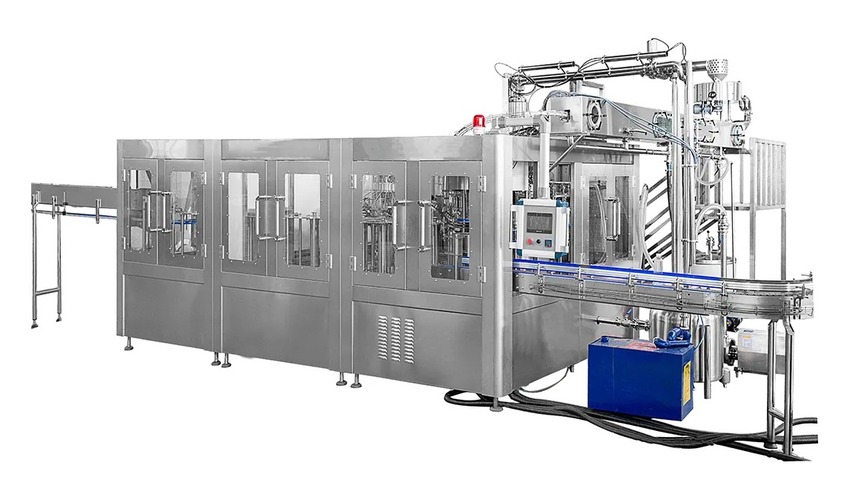
The filling process determines your equipment budget, packaging options, shelf-life ceiling, and the markets you can serve. For juice producers, the decision comes down to three routes: hot fill, cold fill, and aseptic fill. Each is technically viable, but only one will match your product’s pH, your target shelf life, and your distribution reality.
This guide separates the process principles, the measurable trade-offs, and the product-matching logic so you can narrow the choice before requesting equipment quotes.
What Is Hot Fill?
Hot fill is a process where juice is pasteurized, held at fill temperature, and filled hot into heat-resistant containers so that the product heat sterilizes the container and cap contact surfaces.
How Hot Fill Works
The process runs in a fixed sequence. The juice is first sterilized by UHT or pasteurization, then held in a buffer tank at fill temperature, filled into the bottle while hot, and capped immediately. The sealed bottle is then turned or cooled so that the hot product contacts the entire inner surface, including the headspace and cap.
Typical parameters from SinoPAK hot-fill juice lines:
- UHT sterilization: 115–125°C for 5–15 seconds
- Hot fill temperature: 85–92°C for standard juice products
- Medium-temperature option: 65–72°C depending on formula
- Micro negative pressure filling to control fill level and reduce oxidation
- Product recirculation returns under-temperature juice to the UHT unit for re-sterilization
Hot fill works because of the combined effect of heat and acidity. It is effective for high-acid products at pH 4.6 or below, where heat-resistant spores cannot germinate in the acid environment. As the sealed bottle cools, it creates a vacuum that helps maintain the seal and shelf stability.
Some hot-fill lines add a bottle warmer after the cooling tunnel to bring the bottle to room temperature gradually, which reduces condensation and improves label adhesion.
What Is Aseptic Filling?
Aseptic filling sterilizes the juice by UHT, cools it to ambient temperature, and fills it into pre-sterilized containers inside a sterile zone maintained at ISO 5 cleanliness.
How Aseptic Filling Works
The process separates product sterilization from the filling environment. Juice is sterilized by UHT, cooled to ambient temperature in a closed circuit, and then filled inside a sterile chamber. The bottles and caps are pre-sterilized before they enter the chamber, and the sterile zone is maintained at positive pressure with HEPA-filtered air so that unfiltered air cannot enter the open product path.
UHT parameters for aseptic juice typically sit in the 135–140°C range for a few seconds, higher than hot-fill pasteurization because the product is cooled before filling and relies entirely on the UHT step for commercial sterility.
The critical infrastructure difference is the cleanroom. Aseptic filling zones use HEPA-filtered laminar airflow with 99.999% efficiency at 0.3 µm and positive-pressure isolation around the open product path. FDA guidelines reference the same ISO 5 threshold for aseptic filling areas.
Aseptic lines for juice follow GMP-aligned hygiene practices for zone classification, air quality monitoring, and personnel flow. Bottle and cap sterilization are validated as part of the line commissioning.
What Is Cold Fill?
Cold fill pasteurizes the juice, cools it to ambient or chilled temperature, and fills it without a sterile environment, relying on refrigeration or preservatives to maintain safety after filling.
How Cold Fill Works
The process pasteurizes the juice, cools it to ambient or chilled temperature, fills it in a clean but non-sterile environment, and then relies on refrigeration or preservatives to prevent microbial growth after filling.
The temperature envelope is lower than hot fill. Cold fill products are typically held and distributed at 0–5°C. Shelf life is correspondingly shorter: commonly measured in weeks rather than months, unless preservatives and modified atmosphere are part of the formulation.
Two process variants fall under cold fill. Flash pasteurization treats the juice at high temperature for a short hold, then cools immediately before filling. In-bottle pasteurization fills the product at lower temperature and pasteurizes the sealed bottle in a tunnel or water bath. Both variants depend on an unbroken cold chain after filling.
Cold fill suits products positioned around freshness and natural character, where the thermal load of hot fill would change the sensory profile.
Hot Fill vs Cold Fill vs Aseptic: Comparison
The table below compares the three processes on the dimensions that most often decide the investment.
| Factor | Hot Fill | Aseptic Fill | Cold Fill |
|---|---|---|---|
| Fill temperature | 85–92°C | Ambient | Ambient or chilled (0–5°C) |
| Sterilization route | Product heat + container heat | UHT + sterile filling zone | Pasteurization + refrigeration / preservatives |
| pH suitability | High-acid (pH < 4.5) | Low-acid and high-acid | Product-specific, often with preservatives |
| Shelf life (unopened) | 6–9 months | 9–12+ months | Weeks, refrigerated |
| Packaging | Heat-set PET or glass | Standard PET acceptable | Standard PET or glass |
| Vitamin retention | Lower (heat exposure) | Higher (brief UHT) | Higher (no fill heat) |
| Flavor profile | Cooked note possible | Fresher | Fresh-style |
| Technical complexity | Lower | Higher | Moderate, cold-chain dependent |
| Typical capacity range (SinoPAK juice lines) | 3,000–36,000 BPH (500 ml basis) | – | – |
Cost reference: At 4,000 BPH, a hot-fill PET line is commonly budgeted at $90,000–$140,000, while an aseptic PET line runs $150,000–$230,000. The premium covers the sterile filler, UHT system, and clean packaging handling. These figures are third-party industry references from FillerScope’s juice line cost guide, not SinoPAK quotations.
Product Quality
Hot fill exposes the juice to heat for a longer cumulative period: pasteurization, holding at fill temperature, and slow cooling in the bottle. This can degrade heat-sensitive vitamins and produce a cooked note in delicate juices.
Aseptic fill uses a brief UHT cycle and fills at ambient temperature, which generally preserves more vitamin C and volatile aroma compounds. The trade-off is that the sterile environment demands stricter process control and validation.
Cold fill avoids fill-stage heat entirely, which supports a fresh-style sensory profile. The limitation is that shelf life depends on an unbroken cold chain.
Shelf Life and Distribution
Hot fill delivers 6–9 months of unopened ambient shelf life. That is sufficient for regional retail, distributor networks, and markets where refrigeration at the point of sale is not guaranteed.
Aseptic fill reaches 9–12+ months and remains shelf-stable at ambient temperature. This makes it the default choice for export, long-distance distribution, and premium products that need a longer commercial window.
Cold fill shelf life is measured in weeks, not months. It only works when the product moves through a refrigerated chain from factory to retail shelf, and when the sales velocity justifies the shorter window.
How to Choose the Right Juice Filling Process
Process selection should start with the product, not the equipment. pH is the first filter; shelf-life target and distribution model are the second and third. Packaging and cost follow from the process choice.
| Product type | Recommended process | Reason |
|---|---|---|
| Orange, mango, mixed fruit (pH < 4.5) | Hot fill | High acidity makes hot fill safe and economical |
| Apple, grape clear juice | Hot fill | Standard process, cost-effective at scale |
| Low-acid juice, dairy blends, plant-based (pH > 4.5) | Aseptic | Low-acid products need UHT + sterile filling |
| Premium or export brands | Aseptic | Longer shelf life, better vitamin and flavor retention |
| Fresh-style, local distribution | Cold fill | Supports fresh positioning when cold chain is reliable |
| Startup or first juice line | Hot fill | Lower investment, simpler operation, proven technology |
pH as the First Filter
The acid rule is the most reliable starting point. Juice below pH 4.5 can be hot-filled because the acidity and heat together prevent pathogen growth. Juice above pH 4.5 cannot rely on acidity, so it needs the stronger sterilization and sterile environment of aseptic filling, or refrigeration plus preservatives in a cold-fill format.
Pulp content adds a second consideration. Pulpy juices may need homogenization before filling to prevent separation, regardless of the sterilization route.
Shelf-Life Requirement
If the product must survive 9 months or more on an ambient shelf, aseptic is the practical route. If 6–9 months is acceptable and the market does not demand chilled distribution, hot fill covers the requirement at lower capital cost.
Cold fill should only be selected when the shelf-life target is deliberately short and the cold chain is under the producer’s control or reliably contracted.
Packaging Requirements by Process
Packaging must match the sterilization route. The key constraints by process are:
- Hot fill: Requires heat-resistant containers such as crystallized heat-set PET or glass, since standard PET deforms above 85°C. Bottle design must also accommodate vacuum paneling during cooling.
- Aseptic: Accepts standard PET because filling is at ambient temperature, but packaging must withstand pre-sterilization and remain sterile until capping. Aseptic juice lines commonly use 38mm necks, while 28mm is typical for carbonated soft drinks.
- Cold fill: Uses standard PET or glass, but the package must support refrigerated storage and account for surface condensation in label and carton selection.
Cost Considerations
Hot fill carries the lowest capital cost of the three routes for the same nominal capacity. Aseptic adds the sterile filler, the cleanroom infrastructure, the validation burden, and the stricter operational discipline, which is why aseptic lines are commonly budgeted at 50–80% above a comparable hot-fill line.
Cold fill sits between the two on equipment cost but shifts cost into refrigeration and distribution. The total investment should be evaluated as a supply-chain decision, not a filling-machine decision.
Upgrade Path
A hot-fill filler cannot be converted to aseptic. If low-acid or export products are part of the long-term plan, specify aseptic from the start rather than treating it as a later retrofit.
Filling Line Configuration
The filling process determines the upstream and downstream equipment list, not just the filler itself. A hot-fill line, an aseptic filling line, and a cold-fill line each follow a different equipment sequence.
Hot Fill Line
Water treatment → juice preparation → UHT or pasteurization → hot-fill buffer tank → hot-fill filler → capper → bottle turner / cooling tunnel → bottle warmer → labeling → packaging.
Aseptic Filling Line
Water treatment → juice preparation → UHT → cooling → aseptic filler in sterile zone → capper → labeling → packaging, with CIP and SIP circuits designed into the hygienic path.
Cold Fill Line
Water treatment → juice preparation → pasteurization → cooling → clean-room filler → capper → refrigerated storage → cold-chain distribution.
SinoPAK configures juice lines from 3,000 to 36,000 BPH on a 500 ml basis, with hot-fill, ultra-clean, and aseptic options available as project-specific configurations. The UHT system, juice mixing, hot-fill machine, cap sterilization, bottle cooling, labeling, and packaging are integrated as a coordinated line rather than selected as standalone machines.
Conclusion
The right process is the one that matches your product’s pH, your target shelf life, your packaging format, and your distribution model. Hot fill covers high-acid juices at the lowest capital cost. Aseptic covers low-acid, premium, and export products that need long ambient shelf life. Cold fill covers fresh-style products when the cold chain is reliable.
If you are planning a juice line or comparing process routes, share your product pH, target shelf life, packaging format, and output requirement with a filling line engineer. A line-specific review will confirm which of the three processes fits your product and your market. Contact SinoPAK to discuss your juice filling project and request a configuration proposal.