

 Français
  Español
  Português
  العربية
 In the edible oil, lubricant, and industrial liquid packaging industries, filling accuracy and production efficiency directly affect product quality and operating costs. Different oils have different viscosity levels, flow characteristics, and filling requirements. Because of this, selecting the right oil filling machine is an important step for manufacturers that want stable production and reliable packaging quality.
At the same time, the wrong filling technology can lead to inaccurate filling, product waste, difficult cleaning, and unnecessary downtime. Understanding how viscosity influences filling performance helps companies choose suitable equipment for long-term production needs.
What Does Viscosity Mean in Oil Filling?
Before selecting equipment, it is important to understand viscosity. Viscosity refers to how thick or thin a liquid is and how easily it flows. Thin liquids flow quickly, while thick liquids move more slowly.
For example:
- Low-viscosity oils include cooking oil, sunflower oil, and light lubricants.
- Medium-viscosity products include motor oil and syrup-like liquids.
- High-viscosity products include grease, honey, gel products, and heavy industrial oils.
Because filling behavior changes with viscosity, manufacturers need different filling technologies for different products. A machine suitable for water-like liquids may not work efficiently for thick oils or sticky products.

Why Viscosity Matters in Oil Filling Machines
When viscosity levels are not considered during equipment selection, several production problems may appear. These include inaccurate filling volumes, dripping nozzles, excessive foaming, and unstable filling speeds.
In addition, thick products create more resistance during filling. This increases the load on pumps, valves, and pipelines. Thin liquids, on the other hand, may flow too quickly and create overflow or splashing if filling speed is not controlled properly.
Therefore, a suitable oil filling machine should match:
- Product viscosity
- Container size
- Production capacity
- Filling accuracy requirements
- Cleaning and maintenance needs
By matching these factors correctly, manufacturers can improve efficiency and reduce operational costs.
Overflow Filling Machines for Low-Viscosity Liquids
For thin and free-flowing liquids, overflow filling machines are commonly used. These machines fill containers to a consistent visual level instead of a precise weight.
Because of their simple structure, overflow fillers are often used for:
- Light edible oils
- Cleaning liquids
- Low-viscosity chemicals
One advantage of this system is its relatively low cost. Maintenance is also simple because there are fewer moving parts.
However, overflow fillers are not ideal for high-viscosity oils. Thick liquids do not flow smoothly through the overflow system, which can reduce filling accuracy and production stability. In addition, bottle shape variations may affect actual fill volume.
For companies requiring high filling precision, other filling technologies are usually more suitable.
Piston Filling Machines for Medium and High Viscosity Oils
As product thickness increases, piston filling machines become a more practical solution. These machines use piston cylinders to pull and dispense a fixed volume of liquid.
Because piston systems can handle thicker products effectively, they are widely used for:
- Lubricating oil
- Engine oil
- Sauce products
- Honey
- Cream and gel products
Another advantage is high volumetric accuracy. Piston fillers can maintain stable filling performance even with products that move slowly.
At the same time, there are some operational considerations. Product changeovers may take longer because the system often requires disassembly and manual cleaning. Regular seal maintenance is also necessary to maintain long-term accuracy.
For manufacturers with multiple product types and frequent cleaning requirements, maintenance time should be carefully evaluated before choosing this system.
Gear Pump Filling Machines for Stable High-Viscosity Filling
For heavy oils and industrial lubricants, gear pump filling systems provide stable flow control and reliable filling performance.
These machines are commonly used for:
- Gear oil
- Industrial lubricants
- Hydraulic oil
- Thick chemical liquids
Because the gear pump creates controlled pressure during filling, it can maintain steady product flow even with high-viscosity materials.
In many factories, gear pump systems are preferred because of their durability and stable long-term operation. However, they also require regular maintenance and cleaning to maintain filling precision.
Compared with simpler systems, gear pump filling machines usually require more installation space and a higher equipment budget.
Flow Meter Filling Machines for High Accuracy and Flexible Production
Today, many modern oil filling machine manufacturers recommend flow meter filling technology for a wide range of viscosity levels. These systems use electronic flow measurement to control filling volume accurately.
Flow meter filling machines are especially suitable for:
- Edible oil filling lines
- Lubricant filling systems
- Multi-product production lines
- Automatic oil bottling plants
One major advantage is flexibility. Operators can quickly adjust filling volume through the control system without replacing mechanical parts. This improves efficiency when switching between bottle sizes or products.
In addition, mass flow meter systems provide highly accurate filling based on weight rather than volume. This helps reduce problems caused by temperature changes or density variation.
Modern automatic oil filling machines with flow meter technology also support:
- Clean-in-place (CIP) systems
- Touchscreen recipe control
- Servo-driven filling
- Automatic reject systems
- Fast product changeovers
Because these systems require less manual adjustment and maintenance, many manufacturers achieve lower long-term operating costs despite higher initial investment.
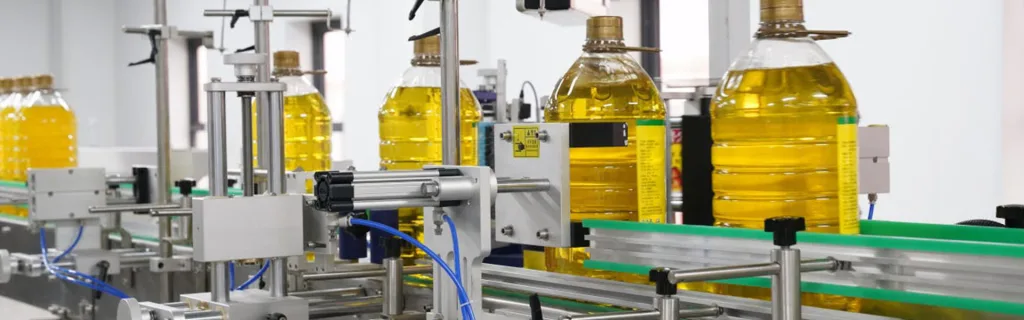
How to Choose the Right Oil Filling Machine
When selecting an oil filling machine supplier, manufacturers should evaluate both current and future production needs.
Several important factors include:
- Product Characteristics: The viscosity, foaming tendency, and temperature sensitivity of the product directly affect filling method selection.
- Production Capacity: Small factories may choose semi-automatic oil filling machines, while high-output plants usually require fully automatic filling lines.
- Filling Accuracy: Industries with strict packaging standards often prefer flow meter or servo-controlled filling systems for higher precision.
- Cleaning and Product Changeover: Factories producing multiple oil products should prioritize equipment with easy cleaning and quick adjustment functions.
- Maintenance and Spare Parts: Reliable after-sales service and spare parts availability are important for reducing downtime and maintaining production stability.
Automation Trends in Oil Filling Equipment
With increasing demand for production efficiency, more factories are upgrading to fully automatic oil filling systems. Modern equipment now integrates:
- PLC intelligent control systems
- Servo motor technology
- Real-time monitoring
- Automatic capping and labeling
- Conveyor integration
These technologies improve filling consistency while reducing labor costs and manual errors.
At the same time, smart monitoring systems help operators quickly identify filling deviations or maintenance needs before major production issues occur.
Conclusion
Choosing the right oil filling machine for different viscosity levels is essential for improving filling accuracy, production efficiency, and long-term operational stability. Different products require different filling technologies, and selecting suitable equipment helps manufacturers reduce waste, improve product consistency, and support future business growth.
Whether handling low-viscosity edible oils or high-viscosity industrial lubricants, manufacturers should carefully evaluate product characteristics, automation requirements, maintenance needs, and production goals before investing in equipment.
As a professional filling and packaging equipment manufacturer, SinoPAK Machinery provides advanced oil filling machine solutions for edible oil, lubricant, and liquid packaging industries. SinoPAK Machinery offers customized filling systems, reliable technical support, and efficient production line solutions to help manufacturers improve packaging performance and production efficiency.
