

 Français
  Español
  Português
  العربية
 Ozone systems are increasingly playing an important role in industrial sectors as an efficient and environmentally friendly technology solution. Whether in water treatment, air purification, or food processing, ozone systems are preferred due to their powerful oxidizing ability and residue-free characteristics. This article will explore the working principle, core components, and practical advantages of ozone systems, providing a better understanding of this technology.
Working Principle of Ozone Systems
Ozone (O₃) is a gas composed of three oxygen atoms, known for its strong oxidizing properties that can rapidly decompose pollutants and disinfect. The operation of an ozone system involves three main steps: ozone generation, reaction with substances, and ozone decomposition.
Ozone Generation
Ozone is typically generated by ozone generators, with common technologies being corona discharge and ultraviolet (UV) methods. The corona discharge method uses a high-voltage electric field to break apart oxygen molecules (O₂) and recombine them into ozone (O₃), while the UV method employs specific wavelengths of UV light to convert oxygen into ozone.
Reaction with Substances
Ozone’s strong oxidizing nature allows it to react with various pollutants. For example, it can break down organic matter, kill bacteria and viruses, and eliminate odors. In water treatment, ozone oxidizes harmful substances in water, while in air purification, it decomposes odors and harmful gases.
Ozone Decomposition
After reacting, ozone naturally breaks down into oxygen (O₂), leaving no harmful residues. This feature makes ozone systems an environmentally friendly solution.
Core Components of Ozone Systems
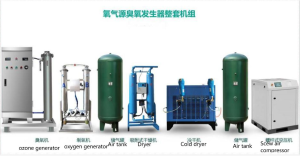
A complete ozone system consists of several key components, each playing a crucial role in its efficiency.
Ozone Generator
The ozone generator is the core device responsible for generating ozone. Modern generators often use variable frequency designs, allowing them to adjust ozone output according to demand, ensuring the system runs efficiently.
Gas-Liquid Mixer
Efficient gas-liquid mixers, like the S-type mixer, ensure that ozone gas and water are thoroughly mixed, improving contact between ozone and pollutants and enhancing reaction efficiency.
Ozone Contact Tower
The ozone contact tower increases the contact time between ozone and water, further improving oxidation efficiency. The design of the contact tower is typically optimized for specific applications to meet various treatment requirements.
Online Monitoring Instruments
Online ozone concentration detectors continuously monitor the ozone levels, ensuring precision and stability. These instruments often have automatic adjustment functions, modifying ozone output based on real-time data.
Applications of Ozone Systems
Ozone systems have widespread applications across many industries, including the following typical use cases:
Water Treatment
Ozone systems are crucial in drinking water purification, wastewater treatment, and industrial effluent processing. They effectively remove organic matter, heavy metals, and microorganisms, ensuring water safety.
Air Purification
In air purification, ozone systems break down odors, harmful gases, and bacteria. They are widely used in hospitals, food processing plants, and public spaces.
Food Processing
In food processing, ozone is used for sterilization, preservation, and removal of pesticide residues. It extends the shelf life of food while ensuring its safety.
Other Industrial Uses
Ozone systems are also used in pharmaceuticals, chemicals, and paper industries for raw material processing, exhaust gas treatment, and process optimization.
Advantages of Choosing Ozone Systems
Ozone systems are popular due to several key advantages:
Efficiency
Ozone’s powerful oxidizing ability allows it to rapidly decompose pollutants, improving processing efficiency.
Environmental Friendliness
After ozone reacts, it naturally decomposes into oxygen, leaving no harmful residues, making it an eco-friendly solution.
Precise Control
With online monitoring instruments and adjustable ozone generators, users can precisely control ozone concentrations, ensuring stable system performance.
Customizable Design
Ozone systems can be tailored to meet specific needs, accommodating different applications and requirements.

Sinopak Machinery’s Ozone System Solutions
Sinopak Machinery is committed to providing efficient and reliable ozone system solutions. Our products feature the following characteristics:
Product Features
Our ozone systems are equipped with high-efficiency S-type gas-liquid mixers and ozone contact towers to ensure thorough contact between ozone and water. We use well-known domestic ozone generators with adjustable output, as well as custom high-efficiency oxidation equipment.
Production Line Process
Our production lines are meticulously designed to ensure high efficiency and stability. Customers can easily understand the system’s operation through detailed flowcharts and parameters.
Conclusion
Ozone systems, as an efficient and environmentally friendly technology, have a wide range of applications in the industrial field. As technology continues to advance, ozone systems will play an even greater role across various sectors. If you are interested in ozone systems, visit Sinopak Machinery’s website to learn more about our products and solutions. We look forward to collaborating with you to advance industrial technology!
