

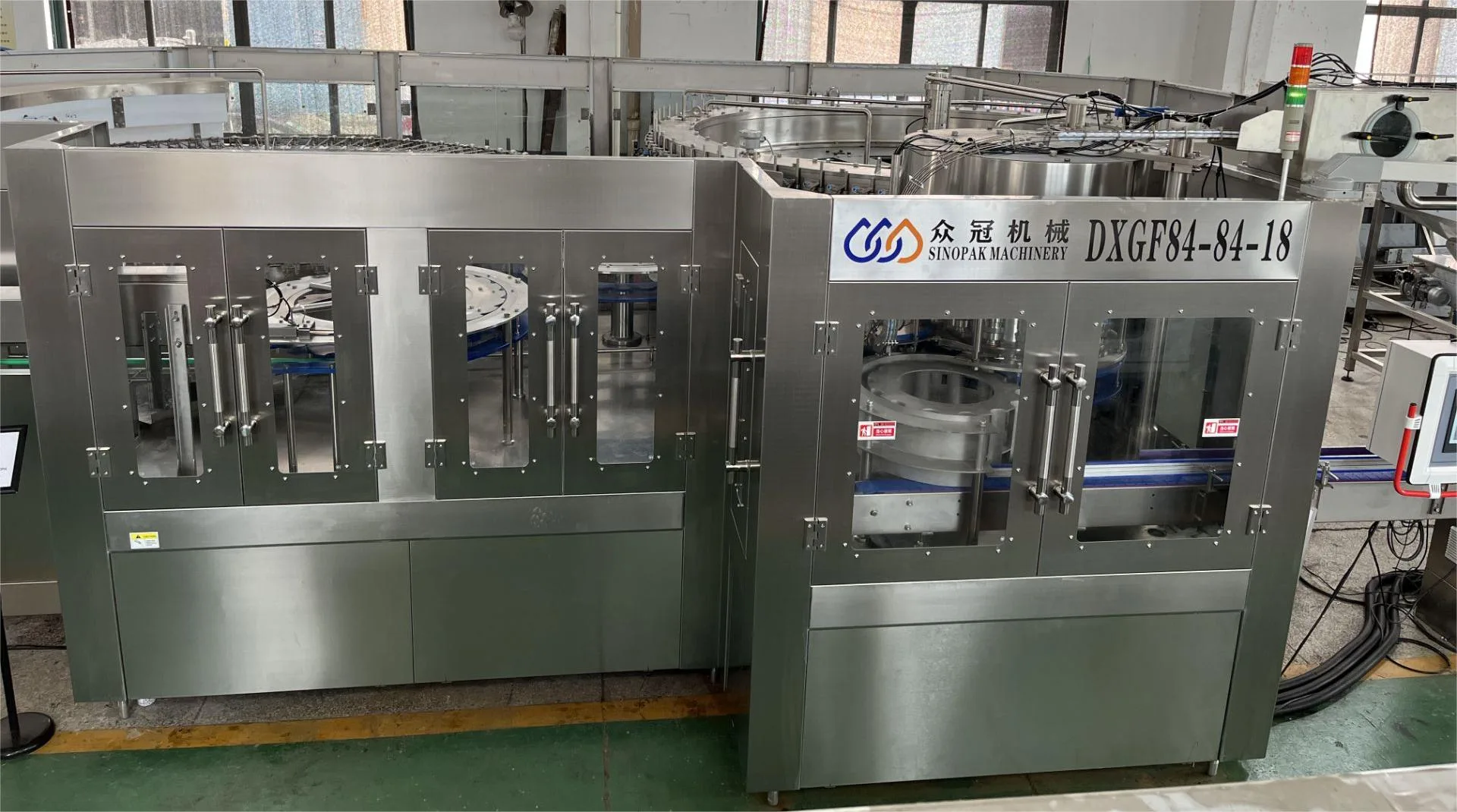
A monoblock filler is a single machine that combines two or more filling line functions into one synchronized unit. Most commonly, it integrates rinsing, filling, and capping. Containers move between these stations inside the machine rather than on open conveyors, which removes the gaps where contamination risk, line imbalance, and mechanical failure occur.
For beverage manufacturers planning a new line or upgrading an existing one, the monoblock configuration has become the baseline configuration for many new beverage lines. This article explains how it works, the main configurations, what operational value it provides, and how to specify one correctly.
How a Monoblock Filler Works
The core principle is that the container never leaves the machine between process steps. It is gripped by the rinser carousel, inverted and flushed, transferred directly to the filling carousel where product is dosed under controlled conditions, and then moved to the capping turret where the closure is applied. All of this happens inside the same hygienic enclosure.
Internal Container Transfer
Containers are handed from station to station by star wheels and neck guides. The bottle neck is the reference point throughout, which keeps the container stable and prevents contact with the body or the open mouth. This internal transfer replaces the open conveyor sections that connect standalone machines.
Synchronized Control
One HMI manages the whole machine. Speed changes, fault detection, and reject logic run through a single control system, so the operator interacts with one interface rather than coordinating three separate machines. For the maintenance team, there is one PLC architecture to understand and one set of alarm codes to troubleshoot.
Types of Monoblock Filler
Monoblocks are usually described by their function set and by the filling principle they use. Both matter when matching a machine to a product.
Triblock, Biblock, and Multi-Function Configurations
A triblock combines rinser, filler, and capper. This is the most common configuration for beverage lines where empty bottles arrive from a blow molding machine or unscrambler. A 3-in-1 glass bottle soft drink filling machine is a typical triblock example for carbonated products in glass containers.
A biblock combines filler and capper only. It suits lines where bottles are already rinsed upstream, or where the rinse step is handled by a separate machine for process reasons.
More complex configurations can add labelling, gas flushing (to displace oxygen in the headspace), or induction sealing (to apply a tamper-evident seal). These are specified when the product or container requires an operation inside the hygienic enclosure.
Filling Valve Technology and Product Matching
The fill valve determines what the machine can run and how accurately it can dose.
- Gravity fill suits still water and clear juice. The product flows from a raised tank into the bottle under its own weight.
- Isobaric (counter-pressure) fill is required for carbonated soft drinks, carbonated water, and beer. The filler bowl and the bottle are kept at equal pressure so that CO₂ stays in solution.
- Electronic flow-meter fill is used for high-viscosity products and products with particulates. The valve measures the actual volume delivered into each container.
- Piston or volumetric fill handles sauces, syrups, and other high-viscosity liquids where a fixed chamber volume is the most reliable dosing method.
Each valve type delivers a different fill accuracy profile, and the required accuracy should be confirmed against the product specification. For a broader comparison of dosing principles, including level, overflow, and load cell filling, see our guide to types of filling machines.
Aseptic and Ultra-Clean Monoblocks
Ultra-clean filling sits between standard and aseptic. It controls the filling environment and container rinse but does not require a full sterile zone.
Aseptic configurations add a sterile zone around the filling and capping area. The zone is maintained at ISO 5 cleanliness with HEPA-filtered air and positive pressure. Bottles and caps are pre-sterilized before they enter the zone.
This configuration is used for low-acid juice, plant-based beverages, and dairy drinks where any exposure after pasteurization creates a spoilage risk. The machine cost and operational discipline are higher than a standard monoblock, so aseptic is specified only when the product and shelf-life target require it.
SinoPAK offers aseptic configurations as project-specific builds on the RXGF juice line platform. Standard hot-fill and ultra-clean configurations are available as catalog models.
Why Beverage Manufacturers Choose Monoblocks
The operational case for a monoblock rests on four points: hygiene, throughput consistency, footprint, and maintenance.
Hygiene and Compliance
Every open transfer point on a filling line is a potential contamination vector that must be assessed, controlled, and documented under a food safety management system. A monoblock reduces the number of these points because the container stays inside the enclosure from rinse to cap.
This is critical for aseptic and ultra-clean filling of juices, dairy, and plant-based beverages. It also matters for still water and carbonated soft drinks, where particulate contamination affects product clarity and shelf life. For facilities operating under FSANZ, SQF, BRC, or HACCP frameworks, fewer open points means a simpler hazard control narrative and less documentation to maintain.
Throughput Consistency
In a monoblock, there is no buffer between rinse, fill, and cap. The line either runs at rated speed or it does not. There is no scenario where the filler is starved by a slow rinser or backed up by a slow capper.
This makes OEE calculation more predictable and root-cause analysis faster. When output drops, the cause is inside one machine, not distributed across three machines and the conveyors between them.
Footprint and Changeover
A triblock occupies substantially less floor space than three standalone machines plus the conveyors, accumulation tables, and guarding needed to connect them. In facilities where floor space is a constraint, this difference is a real commercial factor, not just a layout preference.
Modern monoblock fillers are also designed for faster format changeover. Neck guide adjustments, fill volume parameters, and capping torque settings can often be recalled from stored programs. This reduces the manual adjustment time that limits productivity on multi-SKU lines.
Maintenance Consolidation
One machine means one service schedule, one spare parts inventory, and one set of maintenance records. For plant engineers managing a CMMS and a maintenance budget, consolidating three machines into one reduces administrative overhead and the number of individual wear items to track.
How to Specify the Right Monoblock Configuration
Every production line has its own constraints. The specification process should start with the operations the machine must perform, then move to the details of each station.
Define the Required Operations
Decide first whether the machine needs rinse, fill, and cap, or whether filler and capper are sufficient. If the bottle is already clean when it reaches the filler, a biblock may be the better fit. If the product requires gas flushing or induction sealing, that operation should be defined before the machine layout is fixed.
Confirm Rinser, Filler, and Closer Separately
Each station should be specified on its own terms.
- Rinser: gripper type, nozzle design, rinsing medium (water, sterile air, or chemical agent), and stage timing.
- Filler: valve type, filling principle, product circuit design, and whether vacuum or gas functions are required.
- Closer: capping head type, cap specification, and torque control method.
Output Should Be Confirmed in BPH per Format
Machine capacity should be confirmed in bottles per hour for each product and each bottle format. A single litres-per-hour figure does not capture the effect of fill volume, viscosity, or container size on actual output.
It is also important to distinguish between the maximum quoted capacity and the actual running capacity for a specific project. The two numbers can differ once product characteristics and downstream equipment are taken into account.
Container and Product Inputs
The container and product define the machine’s mechanical and hygienic requirements.
- Container: PET, glass, aluminum can, or HDPE; neck finish (28mm, 30mm, or 38mm); bottle height and diameter range.
- Product: carbonation level, viscosity, fill temperature, and particulate content.
- Hygiene level: standard, ultra-clean, or aseptic.
CIP, SIP, and Format Parts
Confirm whether CIP and SIP circuits are integrated into the machine, and whether a dummy bottle is supplied for cleaning validation. Format parts such as star wheels and guide rails should be designed for tool-free or quick-release changeover.
Monoblock vs. Standalone Machines
The comparison below summarizes the main differences. Neither option is universally better. Standalone machines remain appropriate for some production environments, particularly at lower speeds or where frequent product changes require independent module adjustment.
| Factor | Standalone | Monoblock |
|---|---|---|
| Function integration | Separate machines linked by conveyors | Single machine with internal transfer |
| Open transfer points | Multiple | Reduced |
| Footprint | Larger | Smaller |
| Buffer between stations | Yes | No; line speed is synchronized |
| Control interface | Multiple PLC/HMI systems | Single HMI |
| Typical fit | Low to medium speed, frequent format changes | High speed, where rotary technology is required |
The transition point is not defined by product type. It is usually driven by production speed. Once rotary filling and rotary capping become necessary, integrating both operations into one machine is often the simpler and more space-efficient solution.
Conclusion
A monoblock filler is more than a compact way to combine three machines. It removes the open gaps between rinse, fill, and cap, which improves hygiene control, makes line speed more predictable, and reduces the floor space and maintenance overhead associated with standalone equipment.
SinoPAK monoblock fillers cover still water, carbonated soft drinks, juice and tea, beer, 5-gallon water, and large-format PET bottles. Capacity ranges from 100 BPH on 5-gallon lines to 42,000 BPH on high-speed water lines. Contact SinoPAK to discuss your monoblock filler requirements and request a configuration proposal.