

 Français
  Español
  Português
  العربية
 Water is the essence of life — and in the bottled water industry, purity is everything. Every drop that reaches the consumer’s hands must be safe, crystal clear, and free from contaminants. Achieving that level of quality doesn’t happen by chance; it depends on a series of advanced water treatment and purification processes designed to remove impurities and guarantee safety.
In modern beverage manufacturing, water treatment is the foundation of the entire production line. Without it, even the most advanced filling machines or packaging systems cannot deliver a truly high-quality product.
This article explores the importance of water treatment in bottled water production, detailing the purification steps involved — from filtration and softening to reverse osmosis and sterilization — and explaining how each stage contributes to ensuring safe, consistent, and premium bottled water.
1. Why Water Treatment Matters in Bottled Water Production
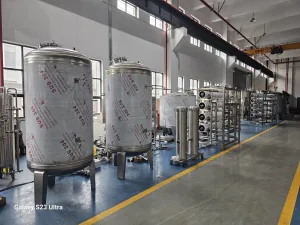
When producing bottled water, raw water sources can vary widely — from municipal supplies and deep wells to natural springs. Each source comes with different characteristics and potential contaminants such as sediments, minerals, bacteria, and organic compounds.
Without proper treatment, these impurities could affect the taste, clarity, safety, and shelf life of bottled water. That’s why water treatment is a non-negotiable step in any professional bottled water production process.
Key Objectives of Water Treatment:
Ensure compliance with international water safety standards (e.g., WHO, FDA)
Remove physical, chemical, and microbiological impurities
Stabilize mineral composition for consistent taste
Protect downstream equipment (filters, pipes, filling valves) from scaling or corrosion
Extend product shelf life and consumer trust
In short, a robust water treatment system ensures that only the cleanest and safest water enters the bottling line.
2. Main Stages of Water Treatment in Bottled Water Production
The water treatment process typically involves several sequential steps, each serving a specific function. Let’s explore these stages in detail:
2.1 Raw Water Pre-Treatment
Before purification, water must undergo pre-treatment to remove large suspended particles and prepare it for finer filtration.
Common pre-treatment methods include:
Sand filtration: Removes large particles like sand, silt, and rust.
Activated carbon filtration: Adsorbs organic substances, chlorine, odors, and color.
Water softening: Uses ion exchange to remove calcium and magnesium, preventing scaling in pipes and machinery.
This stage ensures that subsequent filters and membranes operate efficiently and have a longer lifespan.
2.2 Fine Filtration
After pre-treatment, the water passes through micron-level filters that capture smaller suspended solids and microorganisms.
Cartridge filters (1–5 microns): Remove remaining fine particles.
Precision filters: Provide an additional safeguard before entering the reverse osmosis unit.
This multi-layer filtration ensures clarity and protects the sensitive components of the next purification step.
2.3 Reverse Osmosis (RO) System
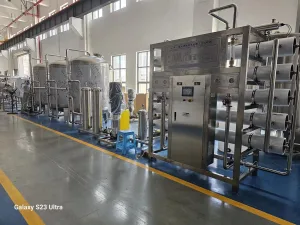
Reverse osmosis is the heart of the water purification process. It uses a semi-permeable membrane to remove up to 99% of dissolved salts, bacteria, and organic matter.
How it works:
Water is pressurized through the RO membrane, allowing only pure water molecules to pass while rejecting contaminants like heavy metals, fluoride, nitrates, and microorganisms.
Benefits of RO in bottled water production:
Produces ultra-pure water suitable for drinking
Ensures consistent taste and mineral balance
Reduces chemical and microbial contamination to negligible levels
SinoPAK integrates high-performance RO systems in its turnkey bottled water production lines to ensure maximum purification efficiency and reliability.
2.4 Deionization and Mineral Adjustment (Optional)
Depending on the desired product type (e.g., mineral water, purified water, alkaline water), the RO-treated water can undergo further modification.
Deionization (DI): Removes residual ions to achieve ultra-high purity.
Mineral addition: Reintroduces beneficial minerals such as calcium and magnesium to enhance taste and nutrition.
This stage ensures that the final bottled water meets both regulatory requirements and brand-specific flavor profiles.
2.5 Sterilization and Disinfection
Even after filtration and RO, trace bacteria or viruses might remain. Therefore, a sterilization stage is essential to guarantee safety before bottling.
Common sterilization methods include:
UV Sterilization: Uses ultraviolet light to destroy bacteria and viruses without chemicals.
Ozone Sterilization: Injects ozone gas into the water, effectively killing microorganisms and decomposing into oxygen, leaving no residue.
Chemical Disinfection (less common): Sometimes used for industrial or non-drinking water, but typically avoided in premium bottled water lines.
These methods ensure the water remains microbiologically stable and safe for long-term storage.
2.6 Storage and Final Filtration
After sterilization, the treated water is stored in a sanitary stainless steel tank before being fed into the filling machine.
To maintain purity:
Tanks and pipelines are closed and pressure-protected to prevent secondary contamination.
A final 0.2-micron filter is usually installed before the filling stage to ensure only sterile water reaches the bottle.
This marks the final checkpoint before bottling — ensuring every product meets the highest hygiene standards.
3. Integration of Water Treatment with Bottling Equipment
In a complete bottled water production line, the water treatment system is fully integrated with filling, capping, and labeling machines.
The treated water flows directly into the filling section under sterile conditions, minimizing handling and contamination risks. SinoPAK’s integrated systems include:
Automatic control via PLC and sensors
Real-time water quality monitoring (TDS, conductivity, pH)
Automatic cleaning-in-place (CIP) systems
This seamless integration ensures that the entire production process — from purification to packaging — maintains the highest levels of hygiene and efficiency.
4. Benefits of a Professional Water Treatment System
A well-designed water treatment system provides measurable advantages for bottled water manufacturers.
4.1 Guaranteed Product Safety
Advanced filtration and sterilization processes eliminate all potential contaminants, ensuring compliance with international drinking water standards.
4.2 Consistent Taste and Quality
By stabilizing mineral content and removing unwanted substances, treatment systems ensure every bottle tastes exactly the same, reinforcing brand consistency.
4.3 Longer Equipment Lifespan
Clean, soft water reduces scaling and corrosion, extending the service life of downstream equipment like filling valves, pumps, and pipes.
4.4 Operational Efficiency
Automated systems reduce manual intervention, allowing continuous, high-volume production with minimal downtime.
4.5 Consumer Trust and Brand Image
Consumers associate purity with trust. Reliable water treatment ensures your brand delivers on that promise — every single bottle.
5. SinoPAK Water Treatment Solutions
At SinoPAK, we design and supply complete water treatment systems tailored for bottled water production. Our systems integrate seamlessly with filling and packaging equipment to create fully automated, high-performance production lines.
Features of SinoPAK Water Treatment Systems:
Multi-stage filtration (sand, carbon, micron, RO, UV, ozone)
Advanced PLC control with touch-screen interface
Stainless steel construction for durability and hygiene
Customizable capacity from small to large-scale plants
Easy integration with bottling, labeling, and packaging machines
SinoPAK’s turnkey solutions ensure you receive not just equipment, but a complete production ecosystem — optimized for efficiency, safety, and long-term profitability.
6. Environmental Considerations in Water Treatment
Sustainability is increasingly important in the bottled water industry. Modern water treatment systems are designed to:
Reduce water waste through RO reject recovery systems
Optimize energy use with intelligent control
Minimize chemical usage by favoring UV and ozone sterilization
Enable water recycling in auxiliary processes (e.g., bottle rinsing)
By combining advanced purification with environmentally responsible design, SinoPAK helps beverage manufacturers achieve both production efficiency and eco-friendly operation.
7. The Future of Water Treatment in Beverage Production
With the rise of smart manufacturing and digital monitoring, water treatment technology is evolving rapidly. Future systems will feature:
AI-driven predictive maintenance
IoT-based remote monitoring of water quality
Automated self-cleaning modules
Data integration across the entire production line
These innovations will enable bottling companies to maintain continuous water purity assurance with minimal human supervision.
8. Why Choose SinoPAK
SinoPAK provides more than machines — we deliver complete beverage production solutions built on technology, quality, and trust. Our water treatment systems ensure your bottled water meets global purity standards while optimizing cost, space, and energy consumption.
Why Clients Choose SinoPAK:
Turnkey solutions: From water treatment to bottling and packaging
Strong engineering and R&D capability
Proven global installations and technical support
Commitment to hygiene, efficiency, and sustainability
With SinoPAK as your partner, you can confidently produce safe, high-quality bottled water that meets international standards and consumer expectations.
Conclusion
Water treatment is the heart of bottled water production. It transforms raw water into a safe, refreshing, and high-quality product that consumers can trust. Through filtration, reverse osmosis, and sterilization, every impurity is removed and every drop is purified to perfection.
For beverage manufacturers, investing in a professional water treatment system isn’t just about compliance — it’s about ensuring quality, brand integrity, and production efficiency.
As one of the industry’s leading solution providers, SinoPAK offers state-of-the-art water treatment systems and complete bottling line integration, helping clients worldwide deliver clean, consistent, and premium bottled water.
