

 Français
  Español
  Português
  العربية
 Choosing the right oil filling machine is a critical decision for manufacturers of edible oils, lubricants, and industrial oils. Unlike water or juice, oil has unique physical properties that directly affect filling accuracy, production efficiency, and packaging quality. Therefore, understanding how to select suitable oil filling equipment can help businesses reduce waste, improve consistency, and achieve stable long-term production.
To begin with, this guide explains the key factors that should be considered when selecting an oil filling machine, helping buyers make informed decisions based on real production needs rather than assumptions.
Why Choosing the Right Oil Filling Machine Matters
First of all, oil products are sensitive to overfilling, leakage, and contamination. If the filling machine is not well matched to the oil type, manufacturers may face frequent downtime, product loss, and customer complaints. In addition, inaccurate filling can increase raw material costs and create compliance issues in regulated markets.
For this reason, selecting the right oil filling machine is not just a technical choice—it is a business decision that affects efficiency, cost control, and brand reputation.
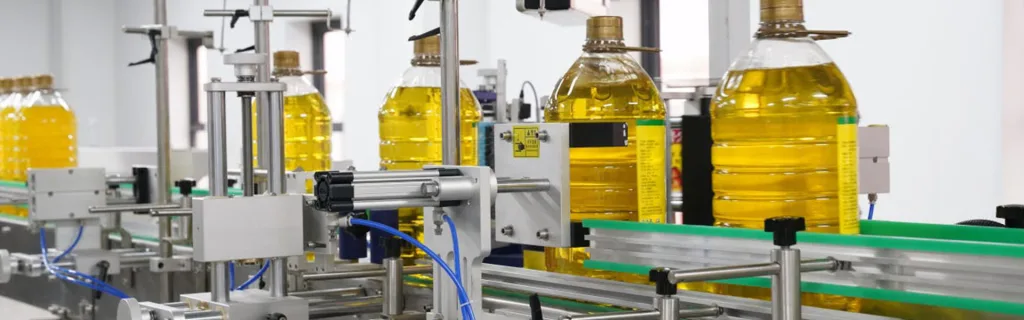
Understand Your Oil Characteristics First
Before selecting any equipment, it is essential to understand the physical characteristics of the oil being filled.
Oil Viscosity and Flow Behavior
In general, oils range from low-viscosity products such as cooking oil to high-viscosity materials like gear oil or engine oil. Higher viscosity oils flow more slowly and require stronger, more controlled filling mechanisms to ensure accuracy and stability.
Additional Oil Properties
Beyond viscosity, factors such as foaming tendency, temperature sensitivity, and whether the oil is food-grade or industrial-grade also play an important role. These characteristics directly influence machine configuration and material selection.
Choose the Right Filling Technology
Once oil properties are clear, the next step is to select the appropriate filling method.
Gravity Filling Machines
Gravity filling machines rely on natural flow and are suitable for low-viscosity oils. While they are simple and cost-effective, they are less suitable for thick oils that require precise volume control.
Pump Filling Machines
Pump-based systems offer better flow control and are widely used for medium-viscosity oils. They provide stable filling performance and are flexible for different container sizes.
Piston Filling Machines
For high-viscosity oils, piston filling machines are commonly used. These machines deliver high accuracy and repeatability, making them ideal for applications where precise volume control is critical.
Define Your Production Capacity Clearly
After selecting filling technology, production capacity becomes the next key consideration.
Manufacturers should evaluate their required output in bottles per hour and consider future expansion. A machine that matches both current demand and expected growth can help avoid unnecessary reinvestment later.
In addition, the number of filling heads and line layout should be planned carefully. Multi-head systems significantly increase output while maintaining consistency across each container.
Focus on Filling Accuracy and Quality Control
Accuracy is especially important in oil filling operations. Overfilling increases material costs, while underfilling can lead to regulatory and customer issues.
Modern oil filling machines typically use volumetric control systems that provide stable and repeatable accuracy. In many cases, consistent accuracy also helps downstream processes such as capping and labeling operate more smoothly.
Consider Container Types and Packaging Flexibility
Another important factor is the variety of containers used in production. Oil products may be packed in bottles, cans, pails, or larger containers.
A practical oil filling machine should be compatible with different container sizes and shapes. At the same time, quick and easy changeover is essential for manufacturers handling multiple SKUs, as it reduces downtime and improves overall line efficiency.
Select the Appropriate Automation Level
Automation level should be chosen based on production scale, labor availability, and budget.
Manual and semi-automatic machines are often used in small-scale operations, while fully automatic oil filling machines are preferred for medium and large factories. Higher automation reduces human error, improves consistency, and supports long-term stable output.
Evaluate Machine Materials, Safety, and Hygiene
Machine construction directly affects durability and safety. Most oil filling machines are built with stainless steel to ensure corrosion resistance and easy cleaning.
In addition, leak prevention and safety features are essential, especially when handling industrial oils. A well-designed machine protects both operators and the production environment.
Maintenance, Cleaning, and After-Sales Support
Beyond performance, maintenance requirements should not be overlooked. Machines that are easy to clean and maintain help reduce downtime and operating costs.
Equally important is the level of after-sales support. Reliable technical service, spare parts availability, and clear documentation are key indicators when choosing an oil filling machine supplier.
Balance Price with Total Cost of Ownership
While price is an important factor, it should not be the only consideration. Energy consumption, maintenance needs, and long-term reliability all contribute to the total cost of ownership.
In many cases, investing in the right machine from the beginning results in better return on investment through reduced waste, higher efficiency, and longer service life.

How to Choose a Reliable Oil Filling Machine Supplier
Finally, working with an experienced oil filling machine supplier can significantly reduce procurement risks. A reliable supplier should offer technical guidance, customization options, and complete filling line solutions based on actual production requirements.
Conclusion
In conclusion, choosing the right oil filling machine requires a clear understanding of oil properties, filling technology, production capacity, and supplier capability. By evaluating these factors step by step, manufacturers can select equipment that supports efficient, accurate, and stable oil packaging operations.
SinoPAK Machinery is an experienced oil filling machine supplier providing professional oil filling solutions for edible oil, lubricant, and industrial oil applications. With a focus on reliable performance, practical design, and customer-oriented service, SinoPAK Machinery helps manufacturers build efficient and scalable oil filling lines.
If you are planning to upgrade or invest in oil filling equipment, SinoPAK Machinery is ready to support your project with proven solutions and expert guidance.
