

 Français
  Español
  Português
  العربية
 A bottled beverage line can fill and cap cleanly and still lose money at labeling. If the labeler cannot hold ±1 mm at the same bottles-per-hour as the filler, you get wrinkled sleeves, skewed OPP wraps, or a buffer that keeps stopping the monoblock. Labeling is not decoration bolted on at the end. It is the station that turns a filled bottle into a sellable SKU with brand, barcode, and legal copy.
This article explains the role of labeling machines in bottled beverage production and how to match labeler type to bottle shape, line speed, and label material. SinoPAK builds labeling equipment for water, juice, CSD, and related PET / glass lines. Start from the labeling machine range.
Where Labeling Sits on a Bottling Line
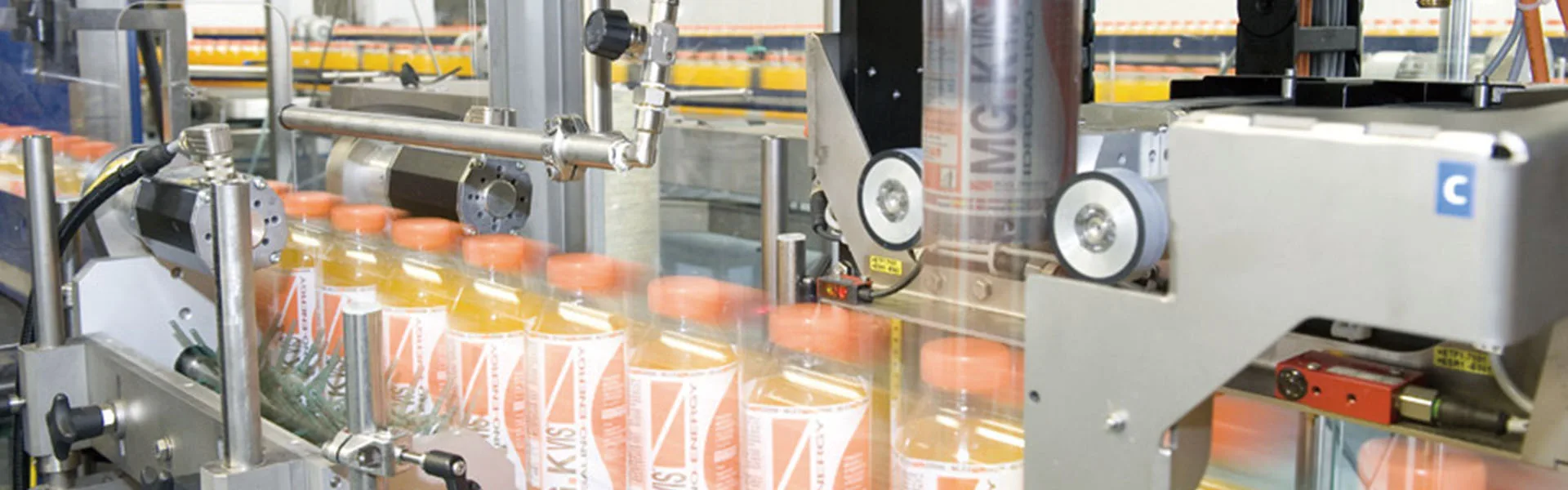
On a typical PET water or soft-drink line the sequence runs from blow molding or bottle infeed through rinse, fill, and cap, then into labeling, optional coding, and finally shrink wrapping or carton packing. After capping, the bottle is closed but still anonymous. The labeler applies the film or paper that shoppers and retailers recognize.
That placement forces three jobs at once. The labeler must match filler speed so the conveyor does not starve or jam, hold placement tight enough for barcode scanners and brand standards, and handle the bottle geometry you actually run—round PET, glass, square packs, or full-body graphics. SinoPAK puts labeling inside turnkey water, juice, and CSD solutions rather than treating it as an isolated gadget. If you are sizing a full line, review the water filling line layout and keep the labeler’s BPH in the same conversation as the filler.
What Labeling Machines Actually Do for Beverage Brands
In beverage plants, labeling machines carry brand graphics, nutrition or ingredient panels, and retail barcodes. They also protect margin. OPP film labeling is widely used on round water and soft-drink bottles because film cost and running cost sit lower than many paper or full-sleeve options when volumes are high.
Process-wise, a modern beverage labeler is PLC-controlled, linked to infeed and outfeed photo-eyes, and tuned to cut or apply film with millimeter-level registration. SinoPAK’s linear OPP hot-melt units list labeling accuracy of ±1 mm and efficiency ≥99.5% across models aimed at round bottles. That is the performance window buyers should demand when the filler already runs thousands of bottles per hour.

Main Labeler Types Used on Bottled Beverage Lines
SinoPAK’s catalog covers the formats beverage plants buy most often. Pick by graphic look, bottle shape, and speed—not by which photo looks newest.
| Labeler type | Best fit on beverage lines | Typical SinoPAK speed band | Watch-outs |
|---|---|---|---|
| Linear OPP hot-melt | Round PET / glass water and soft drinks needing wrap labels at high volume | About 6,000–12,000 BPH (LOPP series) | Built for cylindrical bodies; glue system needs stable air and heat control |
| Rotary OPP | Higher continuous duty on PET round bottles where rotary handling helps stability | Line-matched high-speed OPP work | Heavier footprint and tighter changeover discipline than a simple linear unit |
| Shrink sleeve | Full-body or partial-body graphics on PET, glass, cans, contoured necks | About 6,000–18,000 BPH (SL series) | Needs steam tunnel capacity; PVC / PET / OPS film choice must match market rules |
| Self-adhesive (pressure-sensitive) | Front / back / neck labels, flat or square packs, mid-speed multi-SKU runs | About 3,000–15,000 BPH depending on model | Label cost per bottle is often higher than OPP film at mass water volumes |
OPP hot-melt for round high-volume bottles
For mineral water and many CSD round bottles, linear OPP hot-melt is the workhorse. SinoPAK’s linear automatic OPP hot melt glue labeling machine targets cylindrical containers in glass, metal, or plastic, with label materials OPP, BOPP, or paper and bottle diameters roughly 40–110 mm depending on model. Speed steps include 6,000, 9,000, and 12,000 BPH. The machine syncs to bottle infeed signals so it slows when the discharge backs up and ramps when flow is clear—exactly what you want downstream of a filler. When rotary handling is preferred for PET, use the rotary type OPP labeling machine for PET bottles.
Shrink sleeve when the brand needs full-body coverage
Sleeve labeling wraps the container, then shrinks the film with steam. It covers contoured bottles and supports full-panel graphics that wrap labels cannot match. SinoPAK’s automatic shrink sleeve labeling machine lists body diameters about ∅28–125 mm, label lengths 30–250 mm, films PVC, PET, or OPS, and model speeds from 6,000 BPH up to 18,000 BPH. It can run stand-alone or in-line with filling speed.

Budget the steam tunnel, not only the sleeve applicator. SinoPAK’s SL series pairs the host with a steam shrinking section whose steam demand rises with speed, about 20–50 kg/h across the published models.
Self-adhesive when SKUs and shapes keep changing
Pressure-sensitive labeling fits plants that run flat, square, or multi-panel applications—front and back, neck, sometimes cap top. SinoPAK’s automatic linear self-adhesive labeling machine quotes speed options from 3,000 to 15,000 BPH with about ±1 mm precision. It is a practical choice for specialty drinks, smaller batches, or packs that share a beverage factory with cosmetics-style formats. For pure high-volume round water, OPP film usually wins on label cost.

Why Labeling Becomes the Bottleneck
Buyers often size the filler first and treat labeling as an afterthought. That fails when an 18,000 BPH filler is paired with a sleeve unit that cannot keep up without the matching steam tunnel, when round-bottle OPP is ordered for a square juice pack that needs self-adhesive or sleeve, when changeover time between 500 ml and 1.5 L is ignored in the shift plan, or when glue temperature and label roll quality drift until scrap exceeds the filler’s reject rate. Treat labeling as a capacity-critical station. Match BPH, bottle diameter range, label height, and film type in the same RFQ as the filling monoblock.
How to Spec a Beverage Labeler Without Wasting the Quote Cycle
Send the beverage type (water, juice or tea, CSD, beer, or other), bottle material and shape drawings with min and max diameter and height, target speed in BPH, and whether the labeler must track an existing filler. State the label format—OPP wrap, shrink sleeve full or partial, or self-adhesive panels—plus label size, thickness, and material (OPP, BOPP, paper, PVC, PET, or OPS). Add utility limits for power, air (OPP lines often need about 0.5 MPa), and steam for sleeves. With that brief, a supplier can return a model from the LOPP, SL, rotary OPP, or self-adhesive family instead of a generic “labeling machine” price.
FAQ
What is the role of a labeling machine in bottled beverage production?
After filling and capping, the labeling machine applies brand, legal, and barcode information so the bottle can enter packing and retail. On a SinoPAK-style line it also has to track filler speed; if it cannot, scrap and stoppages show up even when the monoblock itself is healthy.
Which labeling machine should I choose for PET water bottles?
For high-volume round PET water, start with OPP hot-melt—linear for common 6,000–12,000 BPH wraps, or rotary OPP when you want continuous PET handling at higher duty. Choose shrink sleeve only when you need full-body or contoured graphics. Self-adhesive is better for front/back panels or non-round packs than for mass round water.
Can the labeling machine run at the same speed as the filling machine?
Yes, if you size it that way. SinoPAK’s shrink sleeve models publish about 6,000–18,000 BPH and OPP linear models about 6,000–12,000 BPH, with infeed signal control so the labeler slows or ramps with bottle flow. Always quote the filler BPH and bottle diameter together so the labeler is not undersized.
What labeling accuracy should beverage plants expect?
SinoPAK’s linear OPP and self-adhesive units list about ±1 mm placement accuracy. That window matters for barcode scanners and brand face standards on high-speed water and soft-drink lines.
Do shrink sleeve labelers need extra utilities?
They do. Beyond the sleeve applicator, you need a steam shrinking tunnel. SinoPAK’s SL series pairs the host with a steam section that can draw roughly 20–50 kg/h of steam depending on model speed, so plant steam capacity belongs in the RFQ.
Can one labeling machine handle several bottle sizes?
Within the published diameter and label-height range, yes—change parts and setup time still apply. SinoPAK OPP linear models cover roughly 40–110 mm bottle diameters depending on model; shrink sleeve covers about ∅28–125 mm. Put your min/max bottle drawings in the inquiry before assuming one machine covers every SKU.
Practical Takeaway
On bottled beverage lines, labeling machines finish the product for the shelf and protect line OEE. For high-volume round PET water and soft drinks, start with OPP hot-melt, linear or rotary. Move to shrink sleeve when full-body graphics or complex contours are required. Use self-adhesive when shapes and panel layouts keep changing or speeds sit in the mid range.
Next step: send bottle drawings, target BPH, and preferred label material to SinoPAK and ask for a matched proposal from the labeling machine category, sized to your filler—not to a stock photo.
