

 Français
  Español
  Português
  العربية
 Many RFQs say “plastic bottle filling machine” when the plant actually runs PE or HDPE bottles for edible oil, detergent, or chemicals. That wording sends suppliers toward PET water monoblocks that use neck handling and gravity fill—the wrong default for soft PE containers, irregular shapes, and viscous product. A PE bottle filling machine is specified for polyethylene containers and the products they usually carry, not for thin-wall PET soda water.
This article covers the practical advantages of using PE bottle filling machines and how SinoPAK’s oil and chemical lines support that format. Start with the oil and chemical filling machine range.

What “PE Bottle Filling” Means on a Real Line
PE and HDPE bottles are common for cooking oil, lubricants, cleaners, and many household chemicals. They tolerate impact better than glass, take larger formats more cheaply than glass, and often arrive with handles, offset necks, or non-round bodies. SinoPAK’s oil filling pages list packaging materials including plastic and PE, with applicable bottle volumes from about 50 ml to 30 L—exactly the span edible-oil and chemical packers quote.
That is different from SinoPAK’s high-speed PET water 3-in-1 rinse-fill-cap monoblocks for 150 ml–2.5 L round bottles. Those water machines win on BPH for mineral water. PE oil and chemical fillers win when viscosity, drip control, and bottle geometry dominate the brief.
Advantage 1: Format Flexibility From Small Packs to 30 L
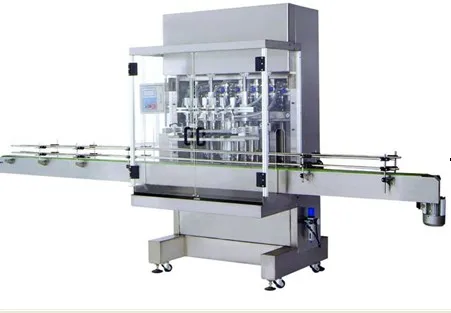
PE bottle programs rarely stay on one SKU. A brand may run 500 ml retail oil, 1 L household detergent, and 5–20 L jerrycan-style packs on related products. SinoPAK’s oil filling machine is built around that range: 50 ml–30 L bottles, plastic or glass, with a bottle-mouth localizer for irregular shapes. Touchscreen volume changes and per-head fine-tuning cut changeover time when the PE bottle set shifts between shifts.

Published model families such as TCL6/8/10-500 and TCL6/8/10-1000 scale nozzle count and air consumption with volume. Line speed for the oil platform sits in a broad band around 2,000–18,000 BPH depending on configuration—enough for most PE oil plants without forcing a PET water-style rotary monoblock.
Advantage 2: Viscous Product Control Without Drip Mess
Edible oil, jam-like concentrates, and many daily chemicals do not behave like water. PE bottle filling machines for these products use piston or servo-controlled dosing so the fill stroke repeats to a set position. SinoPAK highlights anti-drip nozzles, slow-down near target volume to stop mouth splash, and “no bottle, no fill” interlocks. That combination protects PE bottle necks, labels, and conveyors from oil film that otherwise creates slip and rejects.
For plants that also run paste or particulate products in plastic bottles, linear piston fillers in the same family handle low-viscosity liquids through high-viscosity paste. The advantage is one mechanical language across oil, sauce-adjacent packs, and detergent SKUs that share PE containers.
Advantage 3: Accuracy Buyers Can Put in the Spec Sheet
On SinoPAK’s oil and chemical category, filling accuracy is published around ±0.5% on applicable configurations. Servo control keeps the piston stroke consistent; level or volumetric logic keeps PE bottles from looking short-filled on the shelf. For corrosive chemicals, SinoPAK also offers chemical filling machines with corrosion-resistant construction—including HDPE machine materials where metal would degrade—covering roughly 1,000–10,000 BPH and 50 ml–30 L containers.

That accuracy-plus-materials match is a core reason plants choose dedicated PE / chemical fillers instead of adapting a beverage gravity filler.
Advantage 4: Line Add-Ons Built Around PE Oil Bottles
PE cooking-oil bottles often need a handle insert after molding or before packing. SinoPAK’s automatic plastic edible cooking oil bottle handle insert machine sits in the same product family, with bottle ranges around 50 ml–30 L and speed bands roughly 500–10,000 BPH depending on setup. Buying fill and handle handling from one supplier reduces interface gaps between soft PE bottles and downstream packing.
Where PE Fillers Fit Versus PET Water Lines
| Decision point | PE bottle filling (oil / chemical style) | PET water 3-in-1 monoblock |
|---|---|---|
| Typical container | PE / HDPE, often irregular or handled | PET round or square screw-cap bottles |
| Typical product | Oil, viscous liquids, detergents, chemicals | Mineral / purified water, still drinks |
| Volume span on SinoPAK pages | About 50 ml–30 L | About 150 ml–2.5 L on small-bottle water models |
| Fill logic | Piston / servo, anti-drip, viscosity-aware | Gravity or micro-pressure, rinse-fill-cap |
| When to choose | PE oil, chemical, multi-shape plastic packs | High-BPH PET water and soft drinks |
If the brief is truly PET bottled water at 12,000–36,000 BPH, use SinoPAK’s bottle water filling machines. If the brief is PE oil or chemical bottles, stay on the oil and chemical platform.
FAQ
What are the main advantages of using PE bottle filling machines?
They handle polyethylene containers across small retail packs and large jerrycan sizes, control viscous fills with anti-drip dosing, and accept irregular PE shapes that PET water monoblocks are not built for. On SinoPAK equipment, that shows up as 50 ml–30 L coverage, servo/piston accuracy, and PE listed among packaging materials.
Can SinoPAK oil fillers run PE bottles?
Yes. The oil and chemical category lists plastic and PE among packaging materials, with oil, jam-like, and daily-chemical products called out as suitable fills. Confirm bottle drawings and neck finish in the RFQ so the mouth localizer and nozzles are set correctly.
What speed can a PE oil filling line reach?
SinoPAK’s oil filling platform publishes about 2,000–18,000 BPH depending on model and nozzle count. Chemical lines list roughly 1,000–10,000 BPH. Real output still depends on viscosity, PE bottle stability, and whether handles or heavy packs slow the conveyor.
Is a PE bottle filling machine the same as a PET water filling machine?
No. PET water 3-in-1 machines rinse, gravity-fill, and cap thin PET bottles at high BPH. PE oil and chemical fillers focus on volumetric control, drip prevention, and wider bottle geometry. Ordering the wrong family is a common quote mistake.
What bottle sizes can these machines fill?
Oil and chemical pages on SinoPAK state about 50 ml to 30 L. Model tables for the TCL series further break smaller bands such as 50–500 ml and 100–1000 ml by nozzle count. Send min/max PE bottle drawings with the inquiry.
Do PE edible-oil lines need extra equipment beyond the filler?
Often yes. Handle insertion, capping, and secondary packing are common. SinoPAK’s edible-oil handle insert machine is built for plastic oil bottles in a similar volume band, so plan fill and handle steps together when the PE bottle design includes a handle.
Practical Takeaway
Use a PE bottle filling machine when the container is polyethylene and the product is oil, detergent, or chemical—not when you only need a PET water monoblock. The advantages are format range, viscous fill control, published dosing accuracy, and accessories that match PE oil packs.
Next step: send PE bottle drawings, product viscosity, target BPH, and fill volume range to SinoPAK and ask for a matched proposal from the oil and chemical filling category.
